
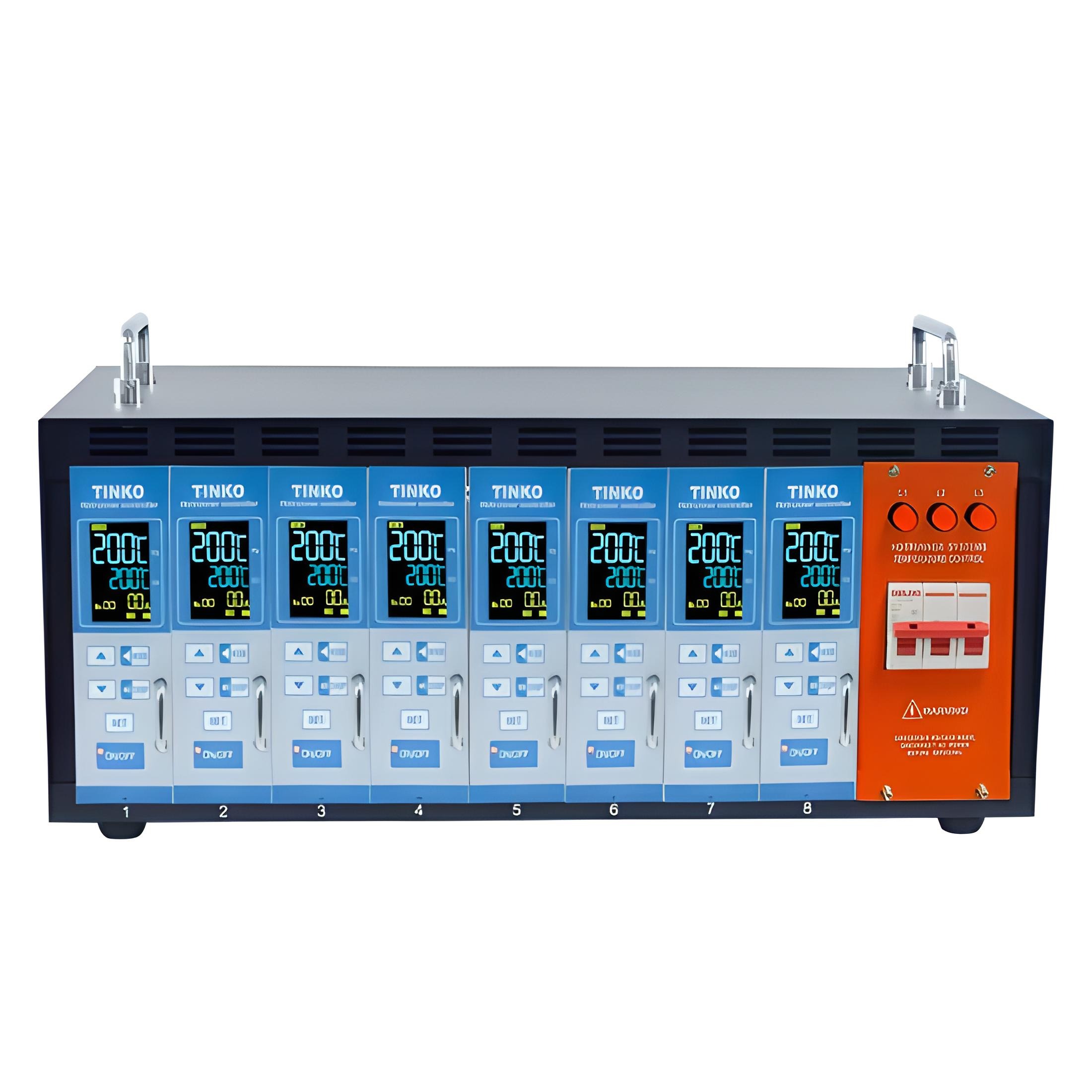
Hot Runner Temperature Controller for Plastic Injection Molding Molds — Precise Zone Control, Better Parts, Less Downtime If you're running a hot runner mold and your temperature control isn't right, everything downstream suffers. Short shots. Burnt gates. Flow lines. Colour streaks. Uneven fill across cavities. These aren't random defects — they're almost always traceable back to temperature instability in the hot runner system. And in most cases, the fix isn't in the mold itself. It's in how well the controller is managing the heat zones. A hot runner temperature controller is the brain of your hot runner system. It monitors and regulates the temperature of every heated zone in the mold — the manifold, the nozzles, and the drops — keeping each one stable at its set point regardless of what's happening in the machine or on the production floor around it. We supply hot runner temperature controllers for injection molding molds — from compact single-zone units for simple hot sprue bushings all the way up to multi-zone systems for complex multi-cavity hot runner molds. If your mold runs hot runners, the right controller makes a measurable difference to part quality, cycle consistency, and mold longevity. What Does a Hot Runner Temperature Controller Actually Do? In a hot runner injection mold, the runner channels stay permanently heated — keeping the plastic in a molten state between shots rather than solidifying like a cold runner. This eliminates runners and sprues entirely, reduces cycle time, and cuts material waste. But it only works if the temperature in each zone is held accurately and consistently. That's the controller's job. The hot runner temperature controller connects to the heating elements and thermocouples installed in each zone of the mold. It reads the actual temperature from the thermocouple, compares it to the operator-set target, and adjusts the power to the heater accordingly — hundreds of times per minute — using PID (Proportional-Integral-Derivative) control logic. The result is a mold where every nozzle and every manifold zone sits at exactly the right temperature, shot after shot, without the operator manually checking or adjusting anything. Get this right and you get: Consistent melt flow through every gate in a multi-cavity mold Clean gate vestige — no stringing, drooling, or gate freeze Uniform part weight and dimensions across all cavities Stable cycle times because fill behaviour doesn't vary between shots Reduced scrap — defects caused by temperature drift simply stop happening Why the Controller Matters as Much as the Hot Runner Itself A lot of mold buyers focus heavily on the hot runner hardware — the manifold brand, the nozzle design, the gate type. Those things matter. But a high-quality hot runner system paired with a poorly performing controller is still going to give you problems. Temperature overshoot during startup can damage heaters or degrade heat-sensitive resins before the first shot is even taken. Slow response to temperature drift during production lets individual zones wander off setpoint undetected. Poor thermocouple diagnostics mean a failed sensor goes unnoticed until defects appear in parts. A well-built hot runner temperature controller handles all of this. Fast response to deviation. Accurate setpoint maintenance during steady-state production. Clear alarms when something needs attention. Soft-start on startup to protect heaters and material. These aren't luxury features — they're the basics of running a hot runner mold reliably. Our Hot Runner Controller Range We supply hot runner temperature controllers across the full zone range, suitable for everything from a single hot sprue bushing to large multi-cavity production molds. Single Zone Controllers (1-Zone) The most compact and cost-effective option. Designed for molds with a single heated zone — typically a hot sprue bushing or a single-nozzle hot tip system. Simple to operate, easy to connect, and the right tool for straightforward applications where you don't need the complexity of a multi-zone unit. Best for: Single-cavity molds, hot sprue bushings, simple open-gate nozzle systems. Small Multi-Zone Controllers (2–12 Zones) The most widely used range in the industry. Suitable for molds with a manifold feeding multiple nozzles — 2, 4, 6, 8, or 12 heated zones depending on the number of cavities and the manifold layout. Each zone is independently controlled with its own setpoint, display, and alarm. Best for: Standard multi-cavity injection molds, family molds, molds with separate manifold and nozzle zone control. Medium Multi-Zone Controllers (12–24 Zones) For more complex molds with a higher number of independently controlled zones. Often used where the manifold itself is divided into multiple temperature zones, or where hot runner systems with individually controlled nozzle tips require precise zone-by-zone management. Best for: High-cavity molds, complex manifold layouts, precision parts requiring tight zone-to-zone temperature balance. Large Multi-Zone Controllers (24–48 Zones and Above) Industrial-scale controllers for large, complex hot runner molds used in high-volume automotive, packaging, and technical parts production. Typically feature touchscreen interfaces, data logging, and advanced diagnostic functions. Best for: Automotive parts molds, high-cavitation packaging molds, complex technical parts requiring advanced process monitoring. Key Features of Our Hot Runner Temperature Controllers PID Auto-Tune Control Our controllers use closed-loop PID control — the industry standard for hot runner temperature management. The auto-tune function automatically calculates the optimal PID parameters for each zone based on the thermal characteristics of that specific heater and thermocouple combination. No manual PID tuning required. Zone temperatures settle quickly and hold accurately. Soft-Start Function On startup — especially after a mold has been cold overnight or over a weekend — the controller brings each zone up to temperature gradually rather than applying full power immediately. This protects heaters from thermal shock, extends element life significantly, and prevents localised overheating of heat-sensitive resins during warmup. Thermocouple Break Detection and Alarm If a thermocouple fails or the connection is broken, the controller detects it immediately and triggers an alarm — rather than running the zone blind on open-loop control. This is critical for preventing overheated zones, degraded resin, and damaged mold components from going undetected. Heater Break Detection Similarly, if a heating element fails, the controller identifies the drop in current draw and alerts the operator. Catching a dead heater zone early prevents the production of off-spec parts from cavities that have gone cold without anyone noticing. Overload and Over-Temperature Protection If a zone exceeds its temperature limit — due to a runaway heater or a thermocouple fault — the controller cuts power to that zone and triggers an alarm. This protection prevents material degradation, heater burnout, and potential mold damage. Independent Zone Control with Individual Displays Each zone has its own setpoint, actual temperature readout, and status indicator. On multi-zone units, the operator can see the status of every zone at a glance — without navigating through menus. Any zone that deviates from setpoint is immediately visible. Boost and Standby Modes Boost mode rapidly raises zone temperatures when starting a new production run after a cold soak — useful for getting up to process temperature faster without manual intervention. Standby mode reduces all zones to a lower holding temperature during planned breaks, protecting heaters and material while saving energy. Universal Thermocouple Compatibility Our controllers are compatible with both Type J and Type K thermocouples — the two most common types used in hot runner systems worldwide. No adapter required for either type. Compact, Rack-Mounted or Standalone Cabinet Designs Available in both rack-mounted card configurations (for integration into a control cabinet) and standalone floor or bench-mount cabinet units. Rack systems allow zones to be added modularly as mold complexity increases. Applications — Industries That Rely on Hot Runner Temperature Controllers Hot runner molds are used across virtually every sector of the plastic injection molding industry. Wherever part quality, cycle time, and material efficiency matter — hot runners are involved. Automotive — Bumpers, door panels, dashboards, interior trims, lighting bezels, under-hood components. Multi-cavity molds with complex manifold layouts demand precise multi-zone temperature control. Packaging — Thin-wall containers, caps and closures, preforms, lids. High-cavitation molds running at very fast cycle times. Temperature balance across all zones is critical for uniform fill and consistent part weight. Medical and Pharmaceutical — Syringes, IV components, inhalers, diagnostic device housings. Tight dimensional tolerances and material sensitivity make temperature precision non-negotiable. Consumer Electronics — Housings, connectors, switches, keyboard components. Cosmetic surfaces and snap-fit dimensions require consistent fill and gate quality across all cavities. Household Goods and Appliances — Storage containers, fittings, appliance parts. High-volume production where material efficiency and cycle consistency drive profitability. Hot Runner Controller vs Cold Runner — Why Temperature Control Changes Everything If you've previously run only cold runner molds, switching to hot runner is a significant step forward in process capability — but it also means the controller becomes a critical piece of equipment rather than an afterthought. In a cold runner mold, temperature variation in the runner has limited impact — the runner solidifies anyway and gets recycled. In a hot runner mold, temperature variation in a zone directly affects the viscosity of the melt at that gate. Lower than setpoint and the gate may partially freeze, causing short shots or fill imbalance. Higher than setpoint and you get gate drool, stringing, or material degradation at the nozzle tip. The controller is what keeps every zone, every cycle, at exactly the right point on that curve. Done well, hot runner molding delivers cleaner parts, faster cycles, and zero runner waste. The controller is what makes 'done well' repeatable. Compatibility — What Hot Runner Systems Do Our Controllers Work With? Our hot runner temperature controllers are compatible with hot runner systems from all major manufacturers, including: Yudo — widely used across Asia and globally Mold-Masters / Mold Masters — popular in automotive and technical parts INCOE — common in European and North American markets Hasco — standard hot runner components DME — widely specified in North American toolrooms Synventive — valve gate and open gate systems Generic and OEM hot runner systems — fitted to many molds built in China, Korea, and Taiwan Compatibility depends on thermocouple type (J or K), connector type, and power requirements per zone. We'll confirm compatibility with your specific hot runner system before dispatch. Frequently Asked Questions 'How many zones do I need?' Count the number of independently heated elements in your mold — each nozzle tip and each manifold heater that you want to control separately is one zone. A simple 4-cavity mold with a single-zone manifold and 4 nozzles would typically need a 5-zone controller. We can help you count zones from your mold drawing or hot runner documentation if needed. 'What's the difference between Type J and Type K thermocouples?' Type J thermocouples have a slightly lower temperature range but are common in older hot runner systems and many Asian-manufactured molds. Type K covers a wider temperature range and is more widely used in modern systems. Our controllers handle both — just confirm which type your mold uses before ordering. 'Can I use one controller for multiple molds?' Yes, if the molds have the same zone count or fewer zones than the controller's capacity. Many toolrooms use a controller per mold for simplicity. Others use a flexible multi-zone unit that's reconnected as molds change. Both approaches work — it depends on how frequently you change molds and how many machines you're running. 'My mold has valve gates — does the controller handle those too?' Standard hot runner temperature controllers manage heating zones only. Valve gate timing — opening and closing the valve pins — is typically handled either by the injection molding machine controller or by a separate sequential valve gate controller. Some advanced integrated units combine both functions. Tell us if you're running valve gates and we'll advise on the right configuration. 'What happens if a heater fails mid-production?' The controller detects the heater failure through the drop in current draw and triggers an alarm for that zone. Depending on your settings, the controller can either hold the last known temperature on that zone (open-loop) or shut it down and alert the operator. Either way, you know about it immediately rather than discovering it through defective parts. 'What's the lead time?' Single and small multi-zone units are available in stock. Larger multi-zone cabinet systems may have a short lead time depending on zone count and configuration. Contact us with your zone count and requirements for availability confirmation. Get the Right Controller for Your Mold A hot runner mold is a significant investment. The temperature controller that runs it should be up to the job — accurate, reliable, and straightforward to use on the production floor. Share your mold's zone count, thermocouple type, and hot runner brand and we'll recommend the right unit with a clear price and lead time.


This is your website preview.
Currently it only shows your basic business info. Start adding relevant business details such as description, images and products or services to gain your customers attention by using Boost 360 android app / iOS App / web portal.
Hot Runner Temperature Controller for Plastic Injection Molding Molds | HRTC for Moulds
2026-06-25T05:00:03
Hot Runner Temperature Controller for Plastic Injection Molding Molds — Precise Zone Control, Better Parts, Less Downtime If you're running a hot runner mold and your temperature control isn't right, everything downstream suffers. Short shots. Burnt gates. Flow lines. Colour streaks. Uneven fill across cavities. These aren't random defects — they're almost always traceable back to temperature instability in the hot runner system. And in most cases, the fix isn't in the mold itself. It's in how well the controller is managing the heat zones. A hot runner temperature controller is the brain of your hot runner system. It monitors and regulates the temperature of every heated zone in the mold — the manifold, the nozzles, and the drops — keeping each one stable at its set point regardless of what's happening in the machine or on the production floor around it. We supply hot runner temperature controllers for injection molding molds — from compact single-zone units for simple hot sprue bushings all the way up to multi-zone systems for complex multi-cavity hot runner molds. If your mold runs hot runners, the right controller makes a measurable difference to part quality, cycle consistency, and mold longevity. What Does a Hot Runner Temperature Controller Actually Do? In a hot runner injection mold, the runner channels stay permanently heated — keeping the plastic in a molten state between shots rather than solidifying like a cold runner. This eliminates runners and sprues entirely, reduces cycle time, and cuts material waste. But it only works if the temperature in each zone is held accurately and consistently. That's the controller's job. The hot runner temperature controller connects to the heating elements and thermocouples installed in each zone of the mold. It reads the actual temperature from the thermocouple, compares it to the operator-set target, and adjusts the power to the heater accordingly — hundreds of times per minute — using PID (Proportional-Integral-Derivative) control logic. The result is a mold where every nozzle and every manifold zone sits at exactly the right temperature, shot after shot, without the operator manually checking or adjusting anything. Get this right and you get: Consistent melt flow through every gate in a multi-cavity mold Clean gate vestige — no stringing, drooling, or gate freeze Uniform part weight and dimensions across all cavities Stable cycle times because fill behaviour doesn't vary between shots Reduced scrap — defects caused by temperature drift simply stop happening Why the Controller Matters as Much as the Hot Runner Itself A lot of mold buyers focus heavily on the hot runner hardware — the manifold brand, the nozzle design, the gate type. Those things matter. But a high-quality hot runner system paired with a poorly performing controller is still going to give you problems. Temperature overshoot during startup can damage heaters or degrade heat-sensitive resins before the first shot is even taken. Slow response to temperature drift during production lets individual zones wander off setpoint undetected. Poor thermocouple diagnostics mean a failed sensor goes unnoticed until defects appear in parts. A well-built hot runner temperature controller handles all of this. Fast response to deviation. Accurate setpoint maintenance during steady-state production. Clear alarms when something needs attention. Soft-start on startup to protect heaters and material. These aren't luxury features — they're the basics of running a hot runner mold reliably. Our Hot Runner Controller Range We supply hot runner temperature controllers across the full zone range, suitable for everything from a single hot sprue bushing to large multi-cavity production molds. Single Zone Controllers (1-Zone) The most compact and cost-effective option. Designed for molds with a single heated zone — typically a hot sprue bushing or a single-nozzle hot tip system. Simple to operate, easy to connect, and the right tool for straightforward applications where you don't need the complexity of a multi-zone unit. Best for: Single-cavity molds, hot sprue bushings, simple open-gate nozzle systems. Small Multi-Zone Controllers (2–12 Zones) The most widely used range in the industry. Suitable for molds with a manifold feeding multiple nozzles — 2, 4, 6, 8, or 12 heated zones depending on the number of cavities and the manifold layout. Each zone is independently controlled with its own setpoint, display, and alarm. Best for: Standard multi-cavity injection molds, family molds, molds with separate manifold and nozzle zone control. Medium Multi-Zone Controllers (12–24 Zones) For more complex molds with a higher number of independently controlled zones. Often used where the manifold itself is divided into multiple temperature zones, or where hot runner systems with individually controlled nozzle tips require precise zone-by-zone management. Best for: High-cavity molds, complex manifold layouts, precision parts requiring tight zone-to-zone temperature balance. Large Multi-Zone Controllers (24–48 Zones and Above) Industrial-scale controllers for large, complex hot runner molds used in high-volume automotive, packaging, and technical parts production. Typically feature touchscreen interfaces, data logging, and advanced diagnostic functions. Best for: Automotive parts molds, high-cavitation packaging molds, complex technical parts requiring advanced process monitoring. Key Features of Our Hot Runner Temperature Controllers PID Auto-Tune Control Our controllers use closed-loop PID control — the industry standard for hot runner temperature management. The auto-tune function automatically calculates the optimal PID parameters for each zone based on the thermal characteristics of that specific heater and thermocouple combination. No manual PID tuning required. Zone temperatures settle quickly and hold accurately. Soft-Start Function On startup — especially after a mold has been cold overnight or over a weekend — the controller brings each zone up to temperature gradually rather than applying full power immediately. This protects heaters from thermal shock, extends element life significantly, and prevents localised overheating of heat-sensitive resins during warmup. Thermocouple Break Detection and Alarm If a thermocouple fails or the connection is broken, the controller detects it immediately and triggers an alarm — rather than running the zone blind on open-loop control. This is critical for preventing overheated zones, degraded resin, and damaged mold components from going undetected. Heater Break Detection Similarly, if a heating element fails, the controller identifies the drop in current draw and alerts the operator. Catching a dead heater zone early prevents the production of off-spec parts from cavities that have gone cold without anyone noticing. Overload and Over-Temperature Protection If a zone exceeds its temperature limit — due to a runaway heater or a thermocouple fault — the controller cuts power to that zone and triggers an alarm. This protection prevents material degradation, heater burnout, and potential mold damage. Independent Zone Control with Individual Displays Each zone has its own setpoint, actual temperature readout, and status indicator. On multi-zone units, the operator can see the status of every zone at a glance — without navigating through menus. Any zone that deviates from setpoint is immediately visible. Boost and Standby Modes Boost mode rapidly raises zone temperatures when starting a new production run after a cold soak — useful for getting up to process temperature faster without manual intervention. Standby mode reduces all zones to a lower holding temperature during planned breaks, protecting heaters and material while saving energy. Universal Thermocouple Compatibility Our controllers are compatible with both Type J and Type K thermocouples — the two most common types used in hot runner systems worldwide. No adapter required for either type. Compact, Rack-Mounted or Standalone Cabinet Designs Available in both rack-mounted card configurations (for integration into a control cabinet) and standalone floor or bench-mount cabinet units. Rack systems allow zones to be added modularly as mold complexity increases. Applications — Industries That Rely on Hot Runner Temperature Controllers Hot runner molds are used across virtually every sector of the plastic injection molding industry. Wherever part quality, cycle time, and material efficiency matter — hot runners are involved. Automotive — Bumpers, door panels, dashboards, interior trims, lighting bezels, under-hood components. Multi-cavity molds with complex manifold layouts demand precise multi-zone temperature control. Packaging — Thin-wall containers, caps and closures, preforms, lids. High-cavitation molds running at very fast cycle times. Temperature balance across all zones is critical for uniform fill and consistent part weight. Medical and Pharmaceutical — Syringes, IV components, inhalers, diagnostic device housings. Tight dimensional tolerances and material sensitivity make temperature precision non-negotiable. Consumer Electronics — Housings, connectors, switches, keyboard components. Cosmetic surfaces and snap-fit dimensions require consistent fill and gate quality across all cavities. Household Goods and Appliances — Storage containers, fittings, appliance parts. High-volume production where material efficiency and cycle consistency drive profitability. Hot Runner Controller vs Cold Runner — Why Temperature Control Changes Everything If you've previously run only cold runner molds, switching to hot runner is a significant step forward in process capability — but it also means the controller becomes a critical piece of equipment rather than an afterthought. In a cold runner mold, temperature variation in the runner has limited impact — the runner solidifies anyway and gets recycled. In a hot runner mold, temperature variation in a zone directly affects the viscosity of the melt at that gate. Lower than setpoint and the gate may partially freeze, causing short shots or fill imbalance. Higher than setpoint and you get gate drool, stringing, or material degradation at the nozzle tip. The controller is what keeps every zone, every cycle, at exactly the right point on that curve. Done well, hot runner molding delivers cleaner parts, faster cycles, and zero runner waste. The controller is what makes 'done well' repeatable. Compatibility — What Hot Runner Systems Do Our Controllers Work With? Our hot runner temperature controllers are compatible with hot runner systems from all major manufacturers, including: Yudo — widely used across Asia and globally Mold-Masters / Mold Masters — popular in automotive and technical parts INCOE — common in European and North American markets Hasco — standard hot runner components DME — widely specified in North American toolrooms Synventive — valve gate and open gate systems Generic and OEM hot runner systems — fitted to many molds built in China, Korea, and Taiwan Compatibility depends on thermocouple type (J or K), connector type, and power requirements per zone. We'll confirm compatibility with your specific hot runner system before dispatch. Frequently Asked Questions 'How many zones do I need?' Count the number of independently heated elements in your mold — each nozzle tip and each manifold heater that you want to control separately is one zone. A simple 4-cavity mold with a single-zone manifold and 4 nozzles would typically need a 5-zone controller. We can help you count zones from your mold drawing or hot runner documentation if needed. 'What's the difference between Type J and Type K thermocouples?' Type J thermocouples have a slightly lower temperature range but are common in older hot runner systems and many Asian-manufactured molds. Type K covers a wider temperature range and is more widely used in modern systems. Our controllers handle both — just confirm which type your mold uses before ordering. 'Can I use one controller for multiple molds?' Yes, if the molds have the same zone count or fewer zones than the controller's capacity. Many toolrooms use a controller per mold for simplicity. Others use a flexible multi-zone unit that's reconnected as molds change. Both approaches work — it depends on how frequently you change molds and how many machines you're running. 'My mold has valve gates — does the controller handle those too?' Standard hot runner temperature controllers manage heating zones only. Valve gate timing — opening and closing the valve pins — is typically handled either by the injection molding machine controller or by a separate sequential valve gate controller. Some advanced integrated units combine both functions. Tell us if you're running valve gates and we'll advise on the right configuration. 'What happens if a heater fails mid-production?' The controller detects the heater failure through the drop in current draw and triggers an alarm for that zone. Depending on your settings, the controller can either hold the last known temperature on that zone (open-loop) or shut it down and alert the operator. Either way, you know about it immediately rather than discovering it through defective parts. 'What's the lead time?' Single and small multi-zone units are available in stock. Larger multi-zone cabinet systems may have a short lead time depending on zone count and configuration. Contact us with your zone count and requirements for availability confirmation. Get the Right Controller for Your Mold A hot runner mold is a significant investment. The temperature controller that runs it should be up to the job — accurate, reliable, and straightforward to use on the production floor. Share your mold's zone count, thermocouple type, and hot runner brand and we'll recommend the right unit with a clear price and lead time.
2026-06-25T05:00:03


Submit Your Enquiry