

Preview

This is your website preview.

Currently it only shows your basic business info. Start adding relevant business details such as description, images and products or services to gain your customers attention by using Boost 360 android app / iOS App / web portal.

THEPLASTICPOINT 6376118bf88fef00017209b4 Products https://www.theplasticpoint.com

3-Axis and 6-Axis Robots for Injection Molding: Choosing the Right Automation for Your Shop Floor

  • 2026-05-11T07:00:01

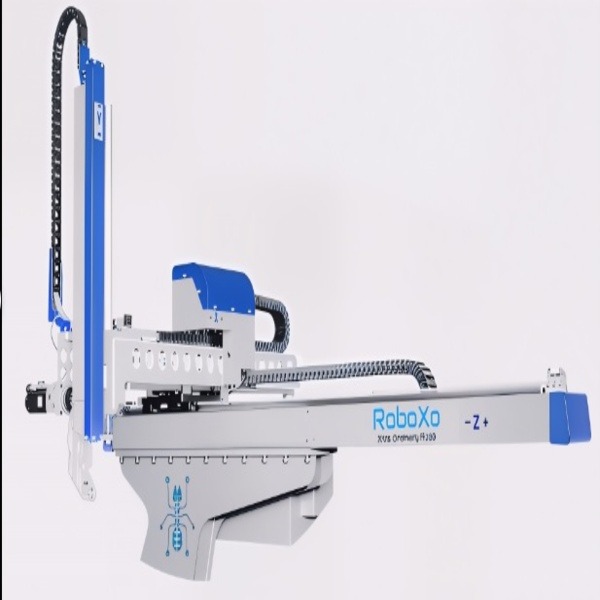
The Automation Crossroads: Which Robot Actually Fits Your Injection Molding Cycle? In the modern plastic shop, the question isn’t if you should automate, but how. When you’re looking to pull parts from an Injection Molding Machine (IMM), you generally find yourself at a crossroads: the high-speed efficiency of a 3-Axis (Cartesian) Robot or the limitless flexibility of a 6-Axis (Articulated) Robot. Choosing the wrong one is an expensive mistake. One might be too slow for your cycle, while the other might be 'over-engineering' a simple task. Here is the 'boots on the ground' breakdown of how to choose. 1. The 3-Axis Robot: The Speed Demon of 'Pick and Place' If your goal is to get the part out of the mold and onto a conveyor belt as fast as humanly possible, the 3-Axis (Top-Entry) robot is your workhorse. Why it works: Blazing Cycle Times: Because they move on a simple X-Y-Z grid (Cartesian coordinates), these robots are incredibly fast. They enter the mold area from the top, grab the part, and exit in a single, fluid motion. Simple Programming: Your floor operators don't need a PhD in robotics. Most 3-axis controllers are intuitive, making them perfect for high-volume, low-complexity jobs. Space Savers: Since they are mounted on top of the fixed platter of the IMM, they don't take up valuable floor space. Best For: Simple part removal, sprue separation, and basic stacking where the part design doesn't change frequently. 2. The 6-Axis Robot: The 'Human Arm' of the Factory A 6-axis robot mimics the movement of a human arm. It can reach around tie-bars, rotate parts mid-air, and perform complex secondary tasks while the machine is still cooling the next shot. Why it works: Complex Geometry: If your part needs to be degated at a specific angle, or if you are doing Insert Molding (where a metal part must be placed into the mold before injection), a 3-axis robot simply can’t compete. Post-Processing Power: A 6-axis robot doesn't just 'pick and place.' It can flame-treat a part, apply a label, or perform ultrasonic welding while the machine is running. It turns your IMM cell into a mini-assembly line. Reach & Flexibility: These robots can be floor-mounted, wall-mounted, or even inverted. They can reach into the mold from the side, which is essential if your factory has low ceiling clearance. Best For: Automotive parts, medical devices with complex inserts, and any setup where secondary operations (trimming, assembly, or inspection) are required. The 'Information Gain' Reality: Which One for You? The 'Cost-Per-Second' Rule If your machine is running a 5-second cycle for thin-wall packaging, every millisecond counts. A 3-axis robot is almost always the winner here because its 'in-mold time' is significantly lower. The 'Value-Add' Rule If you are molding a car door panel that requires three different clips to be installed after it's pulled, a 6-axis robot pays for itself in months by eliminating the need for a manual labor station downstream. Why Integration is the Real Secret Sauce Whether you choose a 3-axis or 6-axis system, the robot is only as good as its handshake with the Injection Molding Machine. We specialize in integrating these systems using the Euromap 67 or Euromap 12 interfaces, ensuring that the robot and the machine 'talk' to each other flawlessly. This prevents 'mold-crash' scenarios and ensures that safety interlocks are always active. Final Verdict Choose 3-Axis if you want speed, simplicity, and low cost for standard parts. Choose 6-Axis if you want to future-proof your facility for complex assemblies and insert molding. Not sure which payload or reach you need? Our team performs on-site cycle-time analysis to help you pick the exact robot for your tonnage. Contact us for a technical consultation.
The Automation Crossroads: Which Robot Actually Fits Your Injection Molding Cycle? In the modern plastic shop, the question isn’t if you should automate, but how. When you’re looking to pull parts from an Injection Molding Machine (IMM), you generally find yourself at a crossroads: the high-speed efficiency of a 3-Axis (Cartesian) Robot or the limitless flexibility of a 6-Axis (Articulated) Robot. Choosing the wrong one is an expensive mistake. One might be too slow for your cycle, while the other might be 'over-engineering' a simple task. Here is the 'boots on the ground' breakdown of how to choose. 1. The 3-Axis Robot: The Speed Demon of 'Pick and Place' If your goal is to get the part out of the mold and onto a conveyor belt as fast as humanly possible, the 3-Axis (Top-Entry) robot is your workhorse. Why it works: Blazing Cycle Times: Because they move on a simple X-Y-Z grid (Cartesian coordinates), these robots are incredibly fast. They enter the mold area from the top, grab the part, and exit in a single, fluid motion. Simple Programming: Your floor operators don't need a PhD in robotics. Most 3-axis controllers are intuitive, making them perfect for high-volume, low-complexity jobs. Space Savers: Since they are mounted on top of the fixed platter of the IMM, they don't take up valuable floor space. Best For: Simple part removal, sprue separation, and basic stacking where the part design doesn't change frequently. 2. The 6-Axis Robot: The 'Human Arm' of the Factory A 6-axis robot mimics the movement of a human arm. It can reach around tie-bars, rotate parts mid-air, and perform complex secondary tasks while the machine is still cooling the next shot. Why it works: Complex Geometry: If your part needs to be degated at a specific angle, or if you are doing Insert Molding (where a metal part must be placed into the mold before injection), a 3-axis robot simply can’t compete. Post-Processing Power: A 6-axis robot doesn't just 'pick and place.' It can flame-treat a part, apply a label, or perform ultrasonic welding while the machine is running. It turns your IMM cell into a mini-assembly line. Reach & Flexibility: These robots can be floor-mounted, wall-mounted, or even inverted. They can reach into the mold from the side, which is essential if your factory has low ceiling clearance. Best For: Automotive parts, medical devices with complex inserts, and any setup where secondary operations (trimming, assembly, or inspection) are required. The 'Information Gain' Reality: Which One for You? The 'Cost-Per-Second' Rule If your machine is running a 5-second cycle for thin-wall packaging, every millisecond counts. A 3-axis robot is almost always the winner here because its 'in-mold time' is significantly lower. The 'Value-Add' Rule If you are molding a car door panel that requires three different clips to be installed after it's pulled, a 6-axis robot pays for itself in months by eliminating the need for a manual labor station downstream. Why Integration is the Real Secret Sauce Whether you choose a 3-axis or 6-axis system, the robot is only as good as its handshake with the Injection Molding Machine. We specialize in integrating these systems using the Euromap 67 or Euromap 12 interfaces, ensuring that the robot and the machine 'talk' to each other flawlessly. This prevents 'mold-crash' scenarios and ensures that safety interlocks are always active. Final Verdict Choose 3-Axis if you want speed, simplicity, and low cost for standard parts. Choose 6-Axis if you want to future-proof your facility for complex assemblies and insert molding. Not sure which payload or reach you need? Our team performs on-site cycle-time analysis to help you pick the exact robot for your tonnage. Contact us for a technical consultation.

  • 2026-05-11T07:00:01

Have any question or need any business consultation?

Have any question or need any business consultation?

Contact Us
Chat with us